Prompt Lab #2: How Well Flux.1 Dev Follows Camera Angle Prompts
If you want fine control of your generated Flux images, mastering the language of camera angles is critical. For something that feels powerful, a low angle shot is ideal. If you want a lay of the land, bird’s-eye view comes into play. If you just want something like a normal conversation with the camera, you’re looking for eye-level. Just prompting “dramatic shot” might not get you want you want.
As someone who generated tons of images, I took it upon myself to do some testing to figure out exactly what Flux.1 Dev understands when it comes to prompting around camera angles, particularly vertical positions.
I ran a focused Flux.1 Dev test on angle only: vertical camera position terms, scored across multiple seeds, and figured out what to add when the film term alone fails. This is that lab note. Honest adherence rates from real generations. Not a scraped tip list.
(Framing was Prompt Lab #1. This one is the next layer in the camera stack.)
Rating scale (adherence rate)
Each prompt term got an adherence percentage from my runs. Asterisks mean the number needs context. Details sit under each term.
The angle stack
This post is only about angle: where the camera sits vertically relative to the subject. Framing, orientation, and lens stay separate labs.
Works cleanly
Eye-level angle: 100%
In this type of shot, the person meets you as an equal. Eyes sit naturally in the face. Forehead, nose, and chin keep familiar proportions. You see whatever is behind them at ordinary standing or sitting height. The picture feels like looking at someone across a table. Every-day stuff.
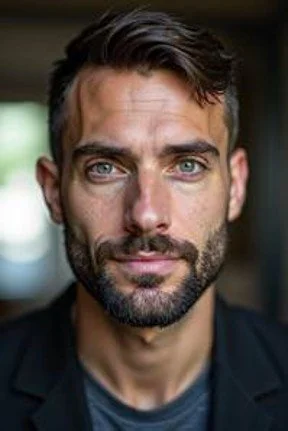
Sample from the angle test export
Low angle: 100%
The person looks tall and substantial in low-angle shots. You see more sky or ceiling than ground. If their head is in view, the chin, jaw, and sometimes nostrils become more visible. The torso and legs can look elongated. Background elements rise behind them.
High angle: 100% (with caveats)
The eyes look a little larger and more open with high-angle shots. If the subject’s head is in view, the forehead takes more of the face. The jaw and neck look slimmer. The underside of the chin is minimized. You often see more of the crown of the head and more of the floor or ground around them.
Caveats from the same test: high-angle full body from the side did not read as high angle. High-angle full body overall sat around 50% adherence in these runs. So things change when your prompt gets more complex than “A high-angle shot photo of a man.”
Bird’s-eye view: 100% (until you over-describe the subject)
Here you should see the top of the head, the plane of the shoulders, and the pattern of the body against the floor, grass, bed, or street. The face appears only if the subject is looking upward. The person becomes a shape in a layout.
If you start describing the subject physically in detail, adherence drops and the camera tends to zoom closer.
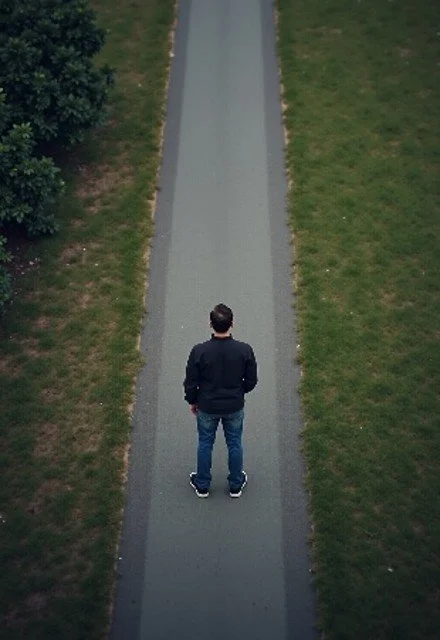
Sample: overhead / layout-style angle from the test export.
Point of view angle: 100% (when you show the “viewer”)
Conceptually, this is a first-person view of a meeting. But without foreground clues, it can look like an ordinary portrait.
To make it feel like the viewer is in the scene, specify what parts of the viewer are in the image, like “Another man’s hands appear in the foreground reaching out to him.”
That kind of literal foreground cue is what locked point of view in these runs. Note that writing out “point of view” seemed to work much better than the POV abbreviation.
Mostly works (with a catch)
Worm’s-eye view: 100%*
In these shots, the sky or ceiling fills most of the frame. The person towers above. Feet or lower body can look huge if they’re close, while the head recedes. Verticals rush upward. The figure feels monumental.
The catch: “A worm's eye view angle photo of a man” alone does not work well. Flux often takes it too literally and invents a worm hole!
But if you pair it with lower-extremity detail and it recovers, for example: “he is wearing blue jeans.”
In short: worm’s-eye needs jeans, shoes, or other lower-body anchors, not the angle label alone.
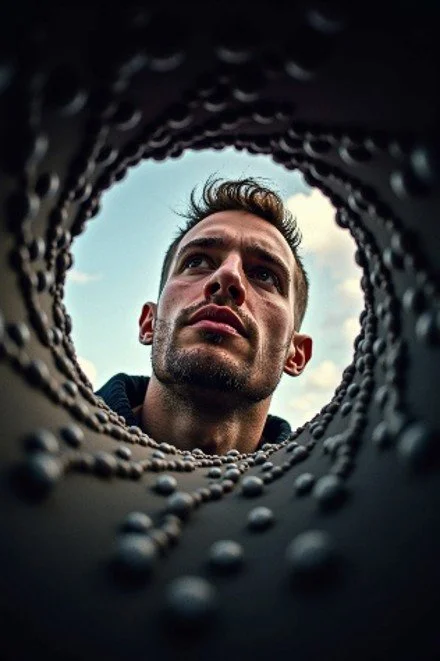
Sample: literal worm-hole miss when worm’s-eye lacks lower-body anchors.
Ground-level shot: 50%*
Here you should see: for outdoor shots, shoes and pavement first, a very low horizon, the person rising tall against street or sky. Indoors: rug, floorboards, chair legs, baseboards as the world.
The catch: once you begin describing the subject, it often turns into a normal portrait. (noticing a pattern?)
What helped: adding ground/floor detail (“The floor is seen in the foreground.”). In these runs, pairing with “low angle” also showed up as a useful nudge.
Treat ground-level as a floor-first prompt, not a face-first one.
Over-the-shoulder angle: 25% (about 75% when you get literal)
You should see the back of one person’s head or shoulder in the foreground and another person’s face beyond them. The picture implies a relationship.
Using bare “over-the-shoulder angle” was weak, but being literal got much better adherence (~75%). For example, adding “taken from behind another man’s shoulder.”
I found that you don’t even need to say “over the shoulder angle” if that literal description is clear.
Fails or fights you
Dutch angle: 0%
The whole scene should lean. Door frames, buildings, and the person’s body run on a diagonal. Nothing sits level.
In this test set, the bare term did not stick. No reliable rewrite emerged from these runs yet. Maybe try rotating the image using photo editing software?
Prompt habits from this lab
Trust eye level, low angle, high angle, bird’s-eye, and point of view when you write them clearly.
High angle + full body is weaker, especially from the side. Do not assume portrait-level adherence on full-figure high angles.
Bird’s-eye hates greedy subject description. Keep physical detail light or it zooms in.
Worm’s-eye needs lower-body anchors (jeans, shoes). Alone, it can go literal and weird.
Ground-level is a floor prompt. Describe the ground early. Subject detail too soon becomes a portrait.
Over-the-shoulder is a relationship crop. Say what is in the foreground (“taken from behind another man’s shoulder”) instead of trusting the film term.
Dutch angle is not ready as a bare Flux.1 Dev term in these tests.
Quick keep / drop
Do more of:
Eye-level angle
Low angle
High angle (especially on closer crops)
Bird’s-eye view with light subject description
Point of View with visible viewer body parts in the foreground
Worm’s-eye paired with jeans / lower extremities
Literal over-the-shoulder description
Do less of (or rephrase):
Dutch angle as a bare term
Over-the-shoulder angle without describing the near shoulder / back of head
Worm’s-eye with no lower-body detail
Ground-level that starts with the face instead of the floor
High-angle full body from the side (expect misses)
This is Prompt Lab #2: camera angle adherence for Flux.1 Dev, scored from my own generations. Framing was #1. Next lab will keep stacking the camera vocabulary we actually use in Hairy AI Guys production.
Hairy AI Guys makes hyper-realistic adult masculine men (daddies, bears, otters, muscle guys) with custom Flux models. Everything is disclosed as AI. Storefront: hairyaiguys.com